
Madhesh Chief Minister Krishna Prasad Yadav to Face Crucial Confidence Vote Today Amid Political Uncertainty
Madhesh Province Chief Minister Krishna Prasad Yadav is set to face a crucial vote of confidence in the Provincial Assembly on Saturday after the CPN-UML and Nepali Communist Party withdrew their support from his government. With 107 members in the Assembly, Yadav needs at least 54 votes to retain his position.
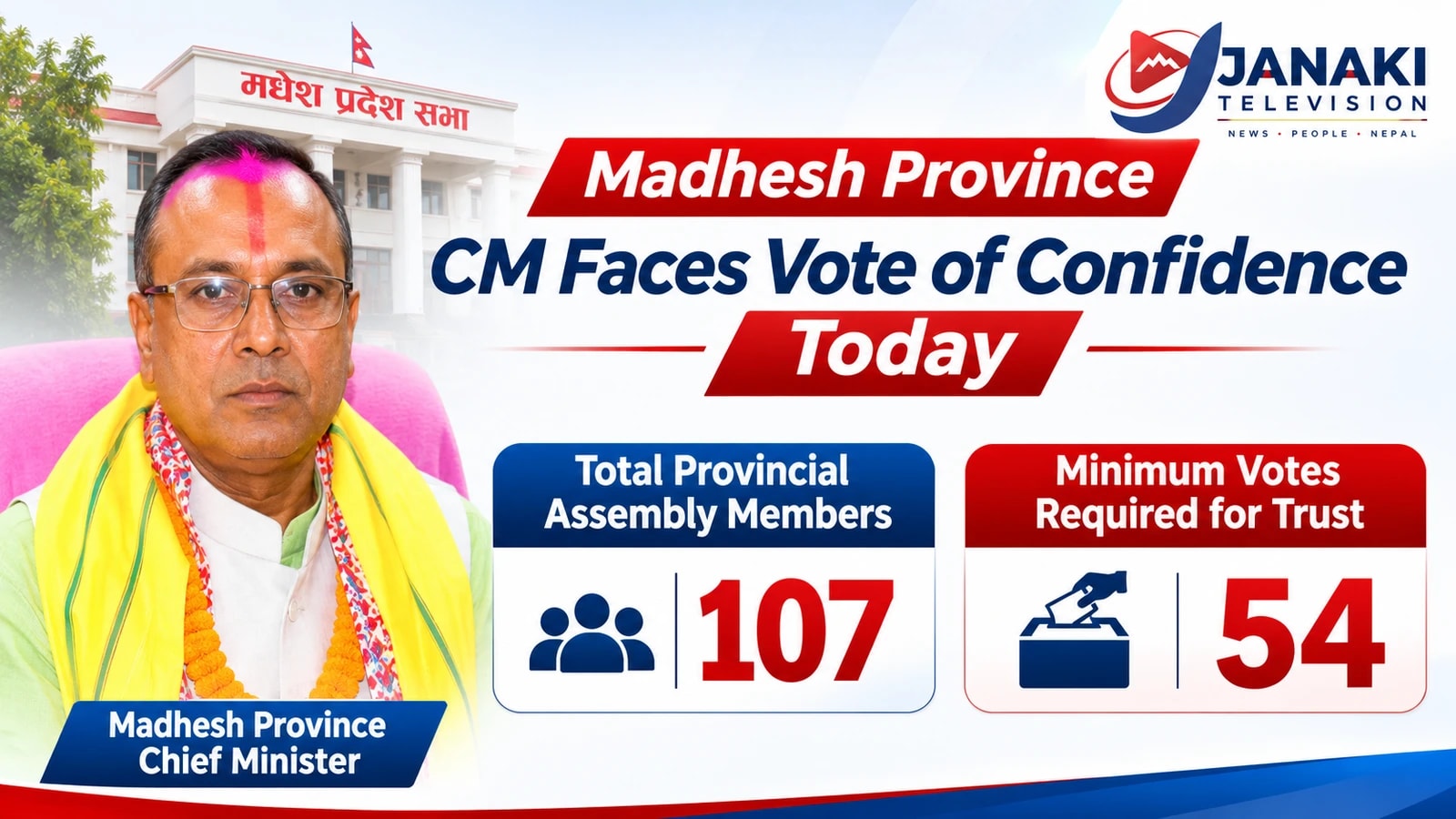
JANAKPURDHAM, November 14: Madhesh Province Chief Minister Krishna Prasad Yadav is scheduled to seek a vote of confidence in the Provincial Assembly at 1:00 pm on Saturday, as his government faces a major political challenge following the withdrawal of support by two coalition partners.
The provincial assembly meeting has been called for Saturday after the Chief Minister requested the Assembly Secretariat to arrange a session for the confidence vote.
According to Provincial Assembly Speaker Ram Ashish Yadav, the meeting is scheduled to begin at 1:00 pm. The Assembly's Business Advisory Committee is also expected to determine the agenda for the session.
The vote has become particularly significant because the Nepali Congress-led provincial government has lost the backing of the CPN-UML and the Nepali Communist Party (NCP), both of which were previously part of the ruling coalition.
The Chief Minister now faces the challenge of securing support from at least 54 members of the 107-member Provincial Assembly to continue in office.
The result is expected to have a direct impact on the political direction and administrative leadership of Madhesh Province.
How did the government reach this crisis?
The political crisis developed after two major coalition partners decided to withdraw their support from the government.
Four ministers representing the CPN-UML resigned collectively on October 11, 2026, and the party withdrew its support from the provincial government.
The situation became more difficult for Chief Minister Yadav when four ministers representing the Nepali Communist Party also resigned on November 6 and the party withdrew its support.
The departure of these two parties significantly weakened the government's position in the Provincial Assembly.
Following the withdrawals, Yadav intensified discussions with political parties in an effort to secure the numbers required to survive the confidence vote.
The Chief Minister has indicated that negotiations with different parties would continue until the vote. However, the political situation remains uncertain, with opposition parties also discussing possible alternatives to the current government.
Madhesh Provincial Assembly: Party-wise seat distribution
The Madhesh Provincial Assembly has a total of 107 members. A government requires the support of at least 54 members to demonstrate a majority.
Opposition parties explore an alternative government
While Chief Minister Krishna Prasad Yadav is attempting to retain his position, opposition parties have also been discussing the possibility of forming a new government.
The Janata Samajbadi Party Nepal has emerged as an important player in these discussions because it is the largest party in the Provincial Assembly.
Saroj Kumar Yadav, the party's provincial parliamentary leader, has emerged as a possible candidate to lead an alternative government.
According to political reporting by Onlinekhabar, UML and NCP leaders have been exploring cooperation with JSP Nepal to replace the existing administration.
However, the party's internal political situation and the position of its national leadership have complicated the negotiations.
JSP Nepal leader Manish Suman has indicated that the party does not favour frequent changes of provincial governments. Nevertheless, he has also said that the party will not support Krishna Prasad Yadav in the confidence vote.
The Janamat Party is also in the opposition, further weakening the prospects of the current government.
These political calculations suggest that the confidence vote is not simply a test of the Chief Minister's popularity but also part of a wider struggle over the leadership of Madhesh Province.
Disagreements between coalition partners
The withdrawal of support has also exposed disagreements between the Nepali Congress and its former coalition partners.
UML leaders have argued that the Chief Minister did not fulfil commitments made during coalition negotiations.
According to UML leader Manoj Paudel, the disagreements included commitments relating to reducing the number of ministries, stopping commissions and avoiding unnecessary interference in the responsibilities of ministers.
However, another UML leader described the reasons being publicly presented as technical justifications, arguing that decisions about provincial governments were also influenced by political developments at the federal level.
The disagreements reflect a broader political struggle over coalition arrangements in Nepal's provincial governments.
The withdrawal of UML and NCP support from Madhesh is linked to wider political realignments between the parties at the federal level.
Madhesh has experienced repeated changes in government
The current crisis has also renewed concerns about political instability in Madhesh Province.
After Nepal's 2022 elections, changes in federal political alliances repeatedly affected the composition of provincial governments.
Madhesh, which had previously completed a full five-year provincial government term following the 2017 elections, has since experienced several changes in leadership.
The sequence of government changes has included administrations led by leaders from the Janamat Party, Loktantrik Samajbadi Party, CPN-UML and Nepali Congress.
Krishna Prasad Yadav became Chief Minister on December 5, 2025, after a seven-party coalition supported his appointment.
His government initially received the backing of 77 Provincial Assembly members, according to reporting by Onlinekhabar.
However, the coalition gradually weakened. Janamat withdrew its support, and the Chief Minister later brought UML into the government to maintain his administration.
The entry of UML led to the dismissal of JSP Nepal ministers, after which JSP Nepal withdrew its support and moved into opposition.
The latest withdrawal by UML and NCP has now placed the Chief Minister in another difficult political situation.
With approximately one year remaining in the Provincial Assembly's term, another change in government could further deepen uncertainty over provincial administration and political stability.
What happens if the Chief Minister fails to secure 54 votes?
The confidence vote will determine whether Krishna Prasad Yadav can continue as Chief Minister.
Under Article 188(2) of Nepal's Constitution, a Chief Minister must seek a vote of confidence when a coalition partner withdraws support.
If the motion receives the required majority, Yadav can continue leading the provincial government.
If he fails to secure the required votes, his position as Chief Minister will become vacant and the constitutional process for forming a new government will begin.
Under Article 168, the Province Chief can invite a member of the Provincial Assembly who can demonstrate majority support to form a government, including through an arrangement involving two or more parties.
If a coalition government cannot be formed under the relevant constitutional provisions, further steps are available under the Constitution, including inviting the leader of the largest party and subsequent procedures.
A failed confidence vote does not automatically mean the Provincial Assembly will be dissolved. The constitutional process for attempting to form another government must be followed.
Why today's vote matters for Madhesh Province
The outcome of the confidence vote will have implications beyond the political future of one Chief Minister.
Madhesh Province faces several major development challenges, including unemployment, agricultural difficulties, infrastructure shortages, education quality, healthcare access and public service delivery.
Frequent changes in government can affect policy continuity, administrative decisions, development programmes and the implementation of provincial budgets.
Political instability can also create uncertainty for government employees, local authorities, development partners and citizens who depend on provincial services.
For residents of Madhesh, the central concern is whether political parties can establish a stable government capable of addressing public needs rather than repeatedly changing coalition arrangements.
The confidence vote is therefore an important test of both the current administration and the ability of provincial political parties to reach a workable agreement.
As the Assembly prepares to meet in Janakpurdham, attention is focused on the numbers each political party will bring to the floor and whether the Chief Minister can secure the support required to remain in office.
The political future of the Madhesh provincial government now depends on the outcome of the confidence vote scheduled for 1:00 pm on Saturday.