India Secures 4,700MW in Nepal, but Major Hydropower Projects Face Delays
Indian government-owned and private companies have secured development rights for seven major hydropower projects in Nepal with a combined capacity of approximately 4,700 megawatts. However, only one project is currently under construction, raising concerns about Nepal’s electricity export ambitions, delayed investments, and the financial benefits expected from cross-border energy cooperation.
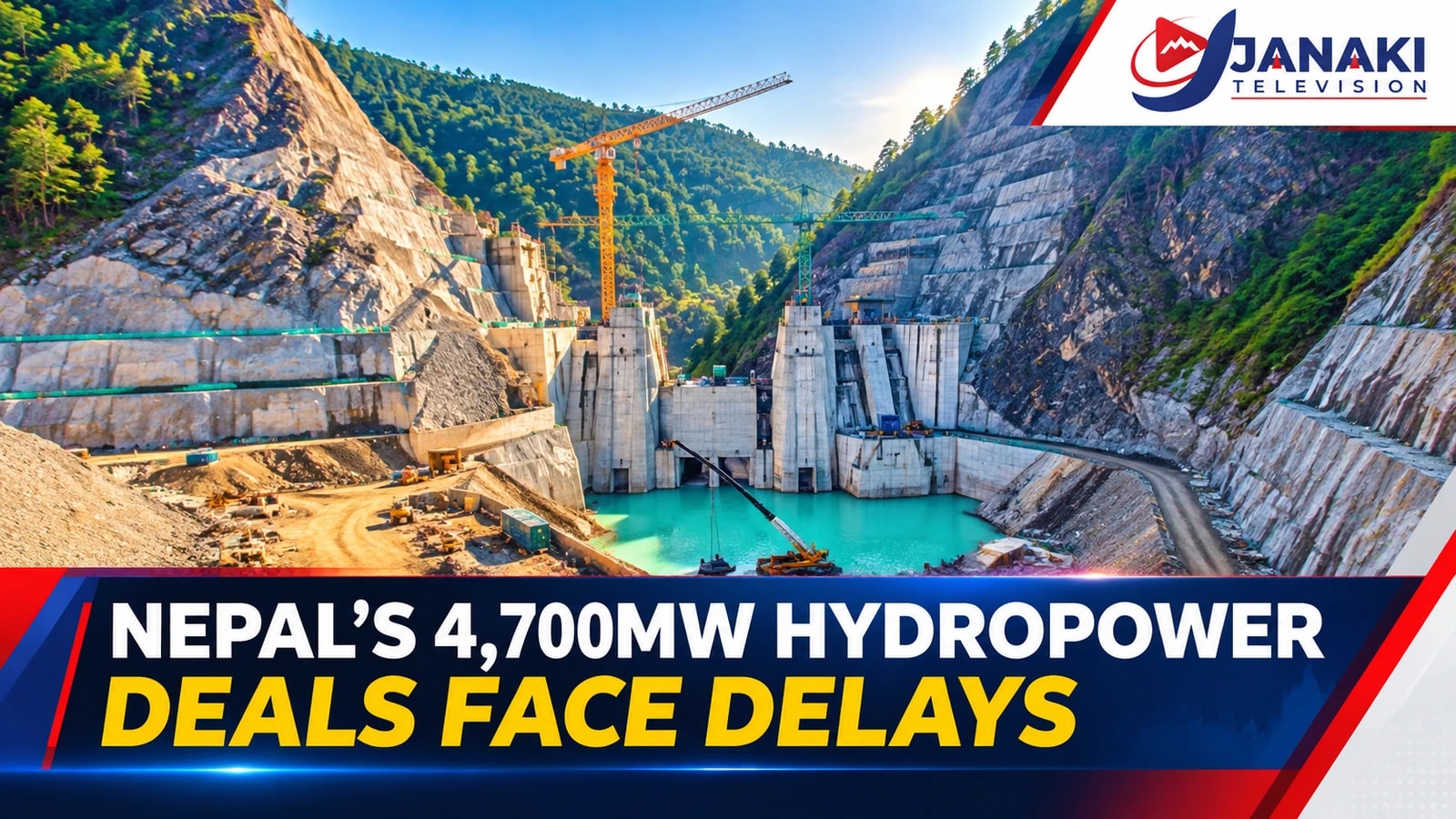
KATHMANDU: Nepal's ambitious plan to expand electricity exports to India is facing significant delays, with only one of seven major hydropower projects awarded to Indian companies currently under construction.
Indian government-owned and private companies have secured development agreements or project commitments for seven hydropower projects with a combined capacity of approximately 4,700 megawatts. However, progress on most of these projects remains slow, raising questions about Nepal's ability to meet its long-term electricity export targets.
The delays could also affect the revenue Nepal expects to generate through electricity exports, royalties and free power arrangements.
In January 2024, Nepal and India signed a long-term agreement under which Nepal aims to export 10,000 megawatts of electricity to India over the next 10 years.
The agreement was widely viewed as a major opportunity for Nepal to utilise its hydropower potential and strengthen its economy through electricity trade.
For India, importing electricity from Nepal supports its efforts to diversify energy sources and reduce dependence on coal-based power generation.
However, the slow progress of major projects has created uncertainty over how quickly Nepal can turn its hydropower potential into actual electricity exports.
Seven Major Projects, but Only One Under Construction
Among the seven major hydropower projects awarded to Indian developers, the 900MW Arun-III project in Sankhuwasabha is currently under construction.
The other projects include:
- Arun-III: 900MW, developed by India's SJVN.
- Arun-IV: Approximately 490MW, planned as a joint venture between Nepal Electricity Authority and SJVN.
- Lower Arun: 679MW, awarded to SJVN.
- Upper Karnali: 900MW, developed by India's GMR.
- West Seti: 800MW, awarded to India's NHPC.
- Seti River-6: 450MW, also awarded to NHPC.
- Phukot Karnali: 480MW, awarded to NHPC.
Together, these projects represent approximately 4,700MW of potential electricity generation capacity.
Despite the scale of these agreements, construction and financial arrangements remain unresolved for most projects.
Arun-III Construction Deadline Pushed to 2028
The 900MW Arun-III Hydropower Project is the most advanced among the major projects awarded to Indian companies.
Developed by SJVN Arun-3 Power Development Company, a subsidiary of India's state-owned SJVN Limited, construction began in 2018.
The project was initially expected to be completed within five years, with commercial electricity generation planned for 2025.
However, delays associated with the COVID-19 pandemic and other construction-related challenges have pushed the completion deadline several times.
According to the latest progress details, 77.5 percent of the power generation component and 60 percent of the transmission line component have been completed.
The latest completion target has been shifted to mid-March 2028.
The estimated project cost stands at approximately Rs144 billion.
The project also includes a 253-kilometre-long 400kV transmission line connecting the powerhouse to Sitamarhi in India.
Under the agreement, Nepal will receive 21.9 percent of the electricity generated by the project free of cost.
The government will also receive royalties and other financial benefits throughout the project's operational period.
Upper Karnali Project Moves Forward After Years of Uncertainty
The 900MW Upper Karnali Hydropower Project, developed by India's GMR Group, has faced years of delays since the initial agreement was signed in 2008.
The project was awarded to GMR through an international competitive bidding process under a build-own-operate-transfer model.
Although the project development agreement was signed in September 2014, construction did not begin as expected.
Financial closure, investment arrangements and other administrative challenges contributed to the prolonged delay.
The Investment Board Nepal recently accepted documents submitted by GMR concerning its financial arrangements, potentially clearing an important obstacle to construction.
The company has presented a financing proposal involving a loan of INR65 billion from the Indian Renewable Energy Development Agency and an in-principle commitment of Rs20 billion from a consortium of Nepali banks.
Nepal is expected to receive 12 percent of the electricity generated by the project free of cost under the project development agreement.
The latest decision is expected to help the project move towards construction, although further implementation steps remain necessary.
West Seti and Seti River-6 Still Await Progress
The West Seti and Seti River-6 hydropower projects in western Nepal have also experienced prolonged delays.
India's state-owned NHPC Limited was selected to develop the two projects after earlier arrangements involving a Chinese developer did not move forward.
The projects have a combined capacity of approximately 1,250MW.
The estimated cost of West Seti is Rs172.51 billion, while Seti River-6 is estimated to cost Rs98.22 billion.
NHPC has submitted detailed project reports, which are being reviewed by the Investment Board Nepal.
However, project development agreements have not yet been finalised.
The company has also raised concerns about the financial viability of the projects, particularly regarding Nepal's demand for free electricity.
NHPC has reportedly informed the government that providing the agreed share of free electricity from all its proposed projects could make some investments financially difficult.
The company has requested viability gap funding from the government to address the financial challenges.
India's Electricity Import Rules Affect Nepal's Projects
Another major challenge facing Nepal's hydropower ambitions is India's electricity import policy.
India has introduced restrictions on electricity imports from projects involving investment from third countries that share a land border with India but do not have the required bilateral power-sector cooperation arrangements.
The provision has created difficulties for Nepalese hydropower projects involving Chinese investment.
The 456MW Upper Tamakoshi Hydropower Project, Nepal's largest operational hydropower project, is one example of the complications.
Although Indian companies were involved in certain components of the project, a Chinese company carried out civil construction work.
India has not granted approval for electricity exports from the project so far.
Nepal has repeatedly raised the issue during bilateral energy discussions, but a final resolution has yet to be reached.
The restrictions have added another layer of uncertainty to Nepal's plans to expand electricity exports to the Indian market.
Cross-Border Transmission Infrastructure Expanding
While hydropower project construction has been slow, Nepal and India have continued expanding electricity transmission infrastructure.
The existing 400kV Dhalkebar-Muzaffarpur transmission line has a transfer capacity of approximately 1,000MW and remains an important route for electricity trade between the two countries.
The two governments have also agreed to increase electricity transfer capacity through additional transmission infrastructure.
The under-construction 400kV Dhalkebar-Sitamarhi transmission line is expected to support increased electricity exports and imports.
Similarly, construction of the Nepal section of the Butwal-Gorakhpur transmission line is targeted for completion by August 2027, while the associated substation is expected to be completed by December 2027.
The two countries have also agreed to move forward with additional transmission projects, including the Inaruwa-New Purnea and Dododhara-New Lamki-Bareilly corridors.
These projects are expected to strengthen the electricity trading network and improve Nepal's ability to export surplus power to India.
Experts Question Delays and Project Agreements
Former Energy Minister Pampha Bhusal has expressed concern over the slow progress of major hydropower projects awarded to Indian companies.
She has argued that India has secured several important projects in Nepal but has not moved quickly enough to complete them.
Former energy officials have also pointed to investment challenges, administrative delays, uncertainty over electricity markets and disagreements about free-power arrangements.
Experts say Nepal must carefully balance the benefits it expects from hydropower agreements with the financial viability of individual projects.
They have also stressed that timely government decisions, clear investment policies and reliable electricity purchase arrangements are essential for accelerating construction.
Nepal's Electricity Export Ambitions at a Critical Stage
Nepal has significant hydropower potential and has increasingly viewed electricity exports as a major opportunity to strengthen its economy.
The 10,000MW export agreement with India offers a long-term framework for expanding bilateral energy trade.
However, the slow progress of major hydropower projects highlights the gap between signed agreements and actual electricity generation.
Without faster construction, financial closure, and reliable cross-border transmission arrangements, Nepal could struggle to achieve its export ambitions within the agreed timeframe.
The coming years will therefore be crucial for determining whether Nepal can transform its hydropower potential into a dependable source of national income and long-term economic growth.