
Three Years After Jajarkot Earthquake, Families Still Waiting for Permanent Homes
Three years after the devastating earthquake that struck Jajarkot and neighbouring Rukum West, many affected families are still living in temporary shelters. Delays in government grants, beneficiary verification, technical assessments, and administrative procedures have slowed reconstruction, leaving thousands of households waiting for permanent homes.
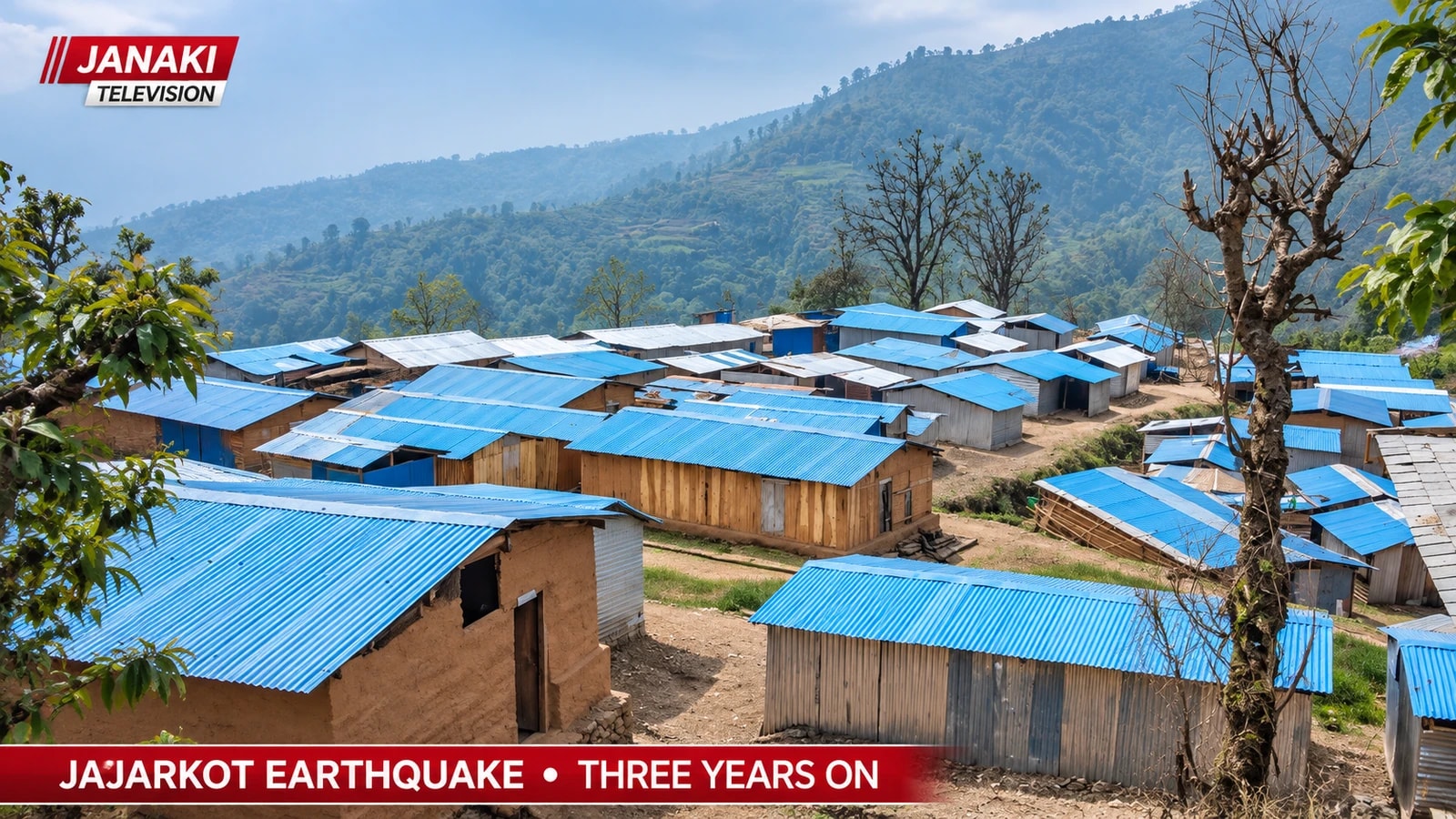
JAJARKOT: Three years after a powerful earthquake devastated parts of western Nepal, many affected families in Jajarkot are still waiting for permanent homes, with reconstruction efforts progressing much more slowly than expected.
The magnitude 6.4 earthquake struck shortly before midnight on November 3, 2023, causing extensive damage in Jajarkot and neighbouring Rukum West.
Among those still struggling is Bagmati Singh of Bheri Municipality-2, whose house was destroyed in the disaster. Her family of five initially lived under a tarpaulin before moving into a temporary tin shelter, hoping that government assistance would soon allow them to rebuild.
However, the family has spent three years waiting for reconstruction support.
Another resident, Ganesh Tiruwa, has faced an even more difficult situation. His family of six lost its home in the earthquake and moved into a temporary shelter. On August 15 this year, a landslide swept away that shelter as well, leaving the family without a secure place to live.
For these households, the delay in reconstruction has become a continuing struggle rather than a temporary problem.
Government Promised Rs 400,000 for Reconstruction
The government had announced financial assistance of Rs 400,000 per household for rebuilding destroyed homes.
However, the release of reconstruction grants has been delayed by administrative procedures, beneficiary verification, and disagreements over damage assessments.
The first phase of the Detailed Damage Assessment (DDA) was completed nearly a year ago, but reconstruction has remained limited.
The assessment classified damaged houses into three categories: those requiring complete reconstruction, those requiring retrofitting, and those needing minor repairs.
However, several earthquake-affected families have complained that they were excluded from the list of eligible beneficiaries despite suffering damage to their homes.
The process has also been slowed by verification requirements, administrative delays and difficulties in finalising agreements with eligible households.
Thousands of Houses Identified for Reconstruction
According to data from the National Disaster Risk Reduction and Management Authority (NDRRMA), the damage caused by the earthquake was extensive.
The disaster killed 154 people, including 101 in Jajarkot and 53 in Rukum West. Another 364 people were injured.
A total of 26,557 houses were destroyed, while 35,455 houses sustained partial damage.
In Jajarkot alone, 48,516 households were identified as eligible for temporary housing assistance. Of these, 35,583 families received Rs 50,000 each.
The detailed damage assessment identified 14,245 houses in Jajarkot for reconstruction and another 12,744 for retrofitting.
Households approved for complete reconstruction are entitled to Rs 400,000, while those eligible for retrofitting can receive up to Rs 300,000.
Despite these provisions, the number of families still waiting for assistance highlights the gap between government commitments and actual implementation.
Local Government Blames Shortage of Technical Personnel
Bheri Municipality Mayor Chandraprakash Gharti said the reconstruction process had been delayed partly because of a shortage of technical personnel required to verify eligible households.
He said the municipality had decided in March to reassess families excluded from the initial damage assessment and had forwarded the decision to the relevant authorities.
However, the reassessment had not yet begun.
Gharti criticised the federal government for delaying the process despite the municipality completing the procedures required at the local level.
The lack of technical staff and delays in administrative approvals have made it difficult for local authorities to move forward with reconstruction.
Only 188 Households Receive First Instalment
The District Administration Office in Jajarkot reported that 1,344 households had completed the required procedures and received approval as reconstruction beneficiaries.
However, Chief District Officer Navaraj Baral said the first instalment of Rs 50,000 each had been released to only 188 households, nearly a year after reconstruction agreements were signed.
Baral said the reconstruction process was expected to accelerate following the arrival of more technical personnel.
More than 50 engineers and technical staff are expected to reach the Jajarkot office of the reconstruction authority after the Tihar festival.
He also said the reassessment of households excluded from the initial damage assessment would move forward after the festival.
According to Baral, amendments to existing reconstruction guidelines are also expected to remove some of the administrative obstacles that have slowed the process.
Temporary Shelters Continue to Create Hardship
For families still living in temporary shelters, the delay has brought difficulties in every season.
Strong winds have damaged or blown away several tin shelters. During winter, rainwater and moisture enter through the roofs, while the metal sheets become extremely hot during summer.
These conditions have made daily life particularly difficult for elderly people, children and families already facing financial hardship.
Unable to afford rebuilding their homes independently, many households continue to depend on government assistance.
Bagmati Singh expressed frustration over the prolonged wait, questioning whether the concerns of poor families would receive attention.
Reconstruction Promises Yet to Become Reality
The government had initially assured earthquake-affected families that permanent housing would be provided within six months.
Three years later, many survivors remain in temporary shelters, while the reconstruction process continues to face administrative and logistical challenges.
The earthquake not only destroyed homes but also disrupted livelihoods and created long-term difficulties for affected communities.
Although the government has announced financial assistance and completed damage assessments, affected families are still waiting for meaningful progress.
The arrival of additional engineers and the proposed revision of reconstruction guidelines may help accelerate the process. However, families in Jajarkot need more than assurances: they need timely financial assistance and safe, permanent housing.
For survivors who have spent three years waiting, rebuilding their homes remains an unfinished promise.