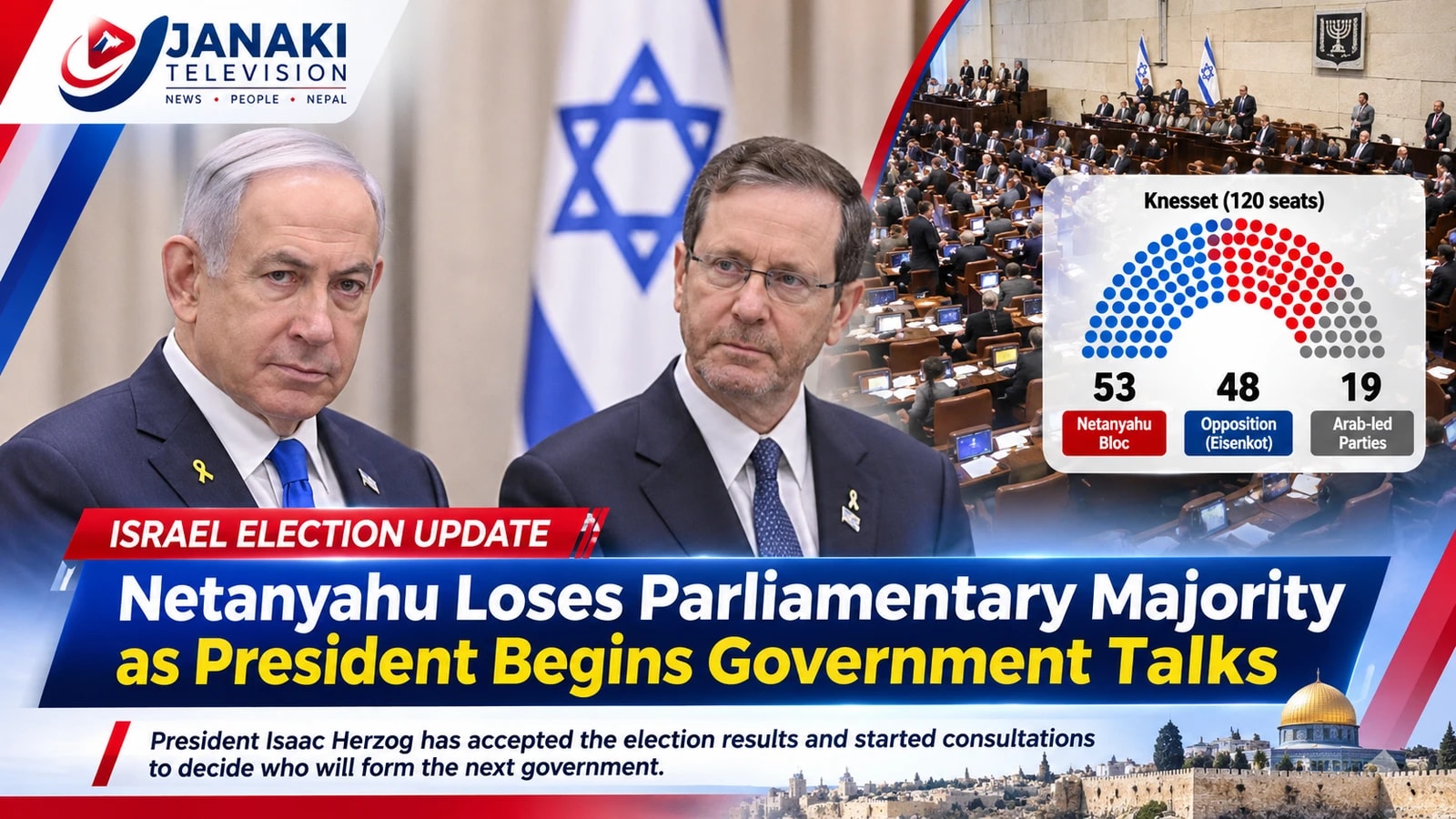
Israel Election Update: Netanyahu Loses Parliamentary Majority as President Begins Government Talks
Israel has entered a period of political uncertainty after Prime Minister Benjamin Netanyahu's bloc lost its parliamentary majority in the October 27 election. President Isaac Herzog has accepted the certified results and started consultations with political parties to determine who should receive the mandate to form the next government.
JERUSALEM: Israel is facing a complicated government-formation process after Prime Minister Benjamin Netanyahu's political bloc lost its parliamentary majority in the October 27 general election.
The final results show that Netanyahu's Likud-led bloc secured 53 seats in the 120-member Knesset, while the opposition bloc led by former military chief Gadi Eisenkot won 48 seats. Arab-led political parties secured a combined 19 seats, giving them a potentially important role in determining the next government.
A political alliance needs at least 61 seats to command a parliamentary majority and form a government.
The results represent a significant setback for Netanyahu, whose outgoing governing coalition held 68 seats in the previous parliament.
President Herzog Begins Government-Formation Consultations
President Isaac Herzog has formally accepted the certified election results and begun consultations with political party leaders.
The consultations are intended to determine which political leader has the strongest support to receive the mandate to form the next government.
Netanyahu's allies have recommended that he be given another opportunity to form a coalition. However, opposition leader Gadi Eisenkot has also received support from several political groups.
The Arab-led Ra'am party has indicated that it will recommend Eisenkot. This could increase his support to approximately 56 lawmakers, although he would still need additional backing to reach the required majority.
The Joint List, another Arab-led political alliance, has also emerged as an important factor in the negotiations.
Once Herzog selects a candidate, that individual will generally have 28 days to form a government, with a possible 14-day extension.
If neither Netanyahu nor Eisenkot can assemble a majority, Israel could face another parliamentary election early next year.
Arab-Led Parties Secure Historic Representation
One of the most significant outcomes of the election was the performance of Arab-led political parties.
The Joint List secured 11 seats, while Ra'am won eight, bringing their combined representation to 19 seats in the Knesset.
This is a record result for Arab-led parties in Israel's parliament and gives them considerable potential influence during coalition negotiations.
Their support could become decisive if Eisenkot attempts to build a government with other opposition parties.
However, cooperation with Arab-led parties remains politically controversial among several Israeli political factions, making the negotiations more complicated.
Election Commission Rejects Fraud Allegations
The election results had faced challenges from Netanyahu and some of his political allies, who alleged that irregularities and possible foreign interference had affected the voting process.
However, Israel's Central Elections Committee said its review found no evidence of irregularities that compromised the integrity of the election or changed the results.
The committee's review covered records from 9,069 polling stations. The official results were subsequently certified.
The committee chairman, Supreme Court Justice Noam Sohlberg, warned that attempts to undermine confidence in the election results could pose a danger to democratic institutions.
A separate investigation into suspected foreign interference by Israel's internal security agency, Shin Bet, remains a distinct matter. Authorities have not publicly established that such interference changed the election outcome.
President Herzog has called for the allegations to be investigated professionally while also condemning racist statements directed at Arab citizens.
What Happens Next?
The immediate priority is to determine whether Netanyahu or Eisenkot can secure the support of at least 61 lawmakers.
Netanyahu remains the leader of the largest individual party, with Likud winning 27 seats. However, the combined strength of his political bloc is insufficient to govern without additional partners.
Eisenkot's opposition alliance also faces the challenge of negotiating with parties whose positions on cooperation with Arab-led factions differ.
The negotiations could take several weeks, and the outcome will determine Israel's political direction during a period of continuing regional security and diplomatic challenges.
For now, the election has changed the balance of power in the Knesset, but Israel does not yet have a confirmed new governing coalition.