
Naresh Bhatt Found Guilty of Murdering Wife Mamta Kafle Bhatt in the United States
A jury in Virginia has found Nepali-origin Naresh Bhatt guilty of first-degree murder in the death of his wife, Mamta Kafle Bhatt, following a nearly six-week trial. The jury also convicted him of concealing and defiling a dead body.
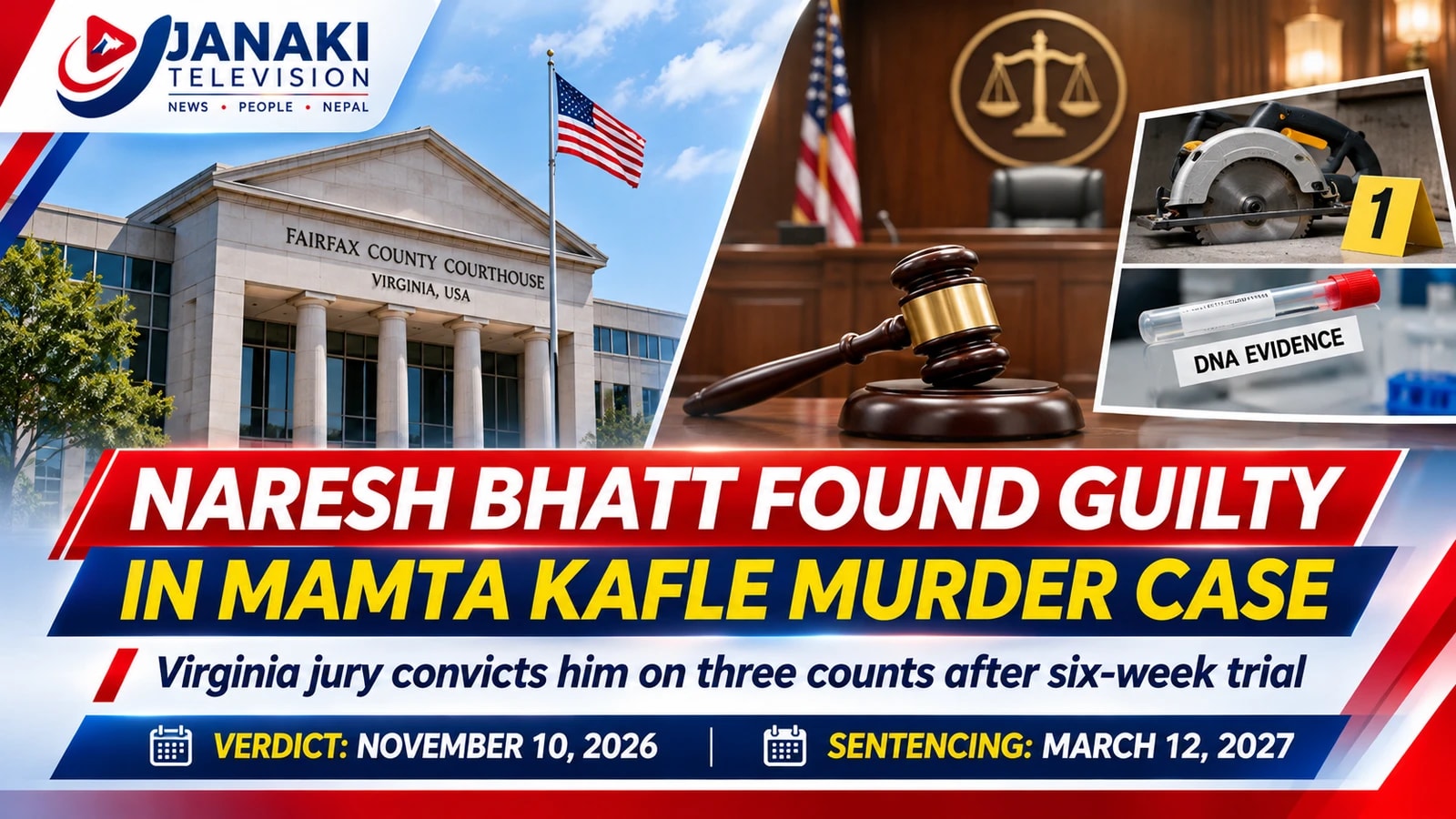
MANASSAS, VIRGINIA: A jury in the US state of Virginia has found Nepali-origin Naresh Bhatt guilty of murdering his wife, Mamta Kafle Bhatt, bringing a major development in a case that has drawn widespread attention among Nepalis both in the United States and Nepal.
The verdict was delivered on Tuesday, November 10, following nearly six weeks of proceedings at the Prince William County Circuit Court.
Jurors found Bhatt guilty of three charges: first-degree murder, concealing a dead body, and defiling a dead body.
The case began after Mamta, a 28-year-old nurse originally from Nepal, disappeared from her home in Manassas Park, Virginia, in July 2024. Her disappearance prompted a police investigation and widespread concern among her family, friends, and the Nepali community.
Despite extensive investigations and a lengthy trial, her remains have never been recovered.
Who Was Mamta Kafle Bhatt?
Mamta Kafle Bhatt was a Nepali-origin nurse living in Manassas Park, Virginia, with her husband and their young daughter.
She worked in the healthcare sector and was known among friends and members of the Nepali community.
Mamta was last known to have been seen in late July 2024. Concern grew when she failed to report for work, prompting colleagues to contact authorities.
Naresh Bhatt later reported her missing on August 5, 2024. Investigators subsequently focused on the couple's home and the circumstances surrounding her disappearance.
Police arrested Naresh Bhatt on August 22, 2024, and charged him in connection with his wife's disappearance and suspected death.
Their daughter was an infant at the time.
What Happened During the Trial?
The trial lasted nearly six weeks and included testimony from numerous witnesses, forensic specialists, investigators, friends, and family members.
Prosecutors argued that Bhatt killed Mamta on or around July 30, 2024, and then attempted to conceal the crime by dismembering her body and disposing of the remains.
The prosecution presented a combination of forensic evidence, surveillance footage, digital records, and witness testimony.
The defence challenged the prosecution's interpretation of the evidence and argued that the circumstances surrounding Mamta's death were different from the prosecution's account.
One of the most significant moments came when Bhatt took the witness stand and admitted that he had dismembered and disposed of his wife's body. However, he denied murdering her.
Bhatt's Account: He Claimed Mamta Had Died by Suicide
During his testimony in November, Bhatt told the court that he found Mamta unresponsive inside their bedroom in July 2024.
He claimed that he noticed vomit containing pills and pesticide containers nearby and attempted to revive her for approximately 45 minutes to an hour.
According to his testimony, he panicked and did not contact emergency services because he feared being blamed.
He told jurors that he subsequently dismembered and disposed of her body.
Bhatt maintained that Mamta had died by suicide and that he had not killed her.
His testimony contradicted earlier statements to investigators, when he had suggested that Mamta had left home and might have travelled to another state.
During cross-examination, he acknowledged that he had lied to police, relatives, friends and neighbours about aspects of the situation.
The prosecution rejected his explanation and argued that the evidence demonstrated that he had deliberately killed his wife and attempted to hide the crime.
Forensic Evidence Played a Major Role
One of the central elements of the prosecution's case was forensic evidence recovered from the couple's home and other locations.
1. Power saw and DNA evidence
Investigators presented evidence concerning a Ryobi power saw that prosecutors believed had been used to dismember Mamta's body.
A Home Depot security investigator testified that surveillance footage showed someone resembling Bhatt purchasing a saw kit, blade, and battery equipment in June 2024.
A landscaper later testified that Bhatt gave him the saw on August 1, 2024, as payment for yard work. The landscaper subsequently handed the equipment to law enforcement.
Investigators found reddish-brown stains and hair-like material on the saw.
A forensic scientist testified that DNA profiles recovered from material inside the saw were consistent with Mamta's profile. The profile was developed using a hairbrush recovered from the home.
The defence questioned the reliability and interpretation of some of the forensic evidence, including the source of the reference sample.
2. Blood evidence from the bedroom carpet
Investigators also examined carpet removed from the couple's bedroom.
Forensic testing identified staining that prosecutors said was consistent with blood from Mamta and the couple's daughter.
A forensic scientist testified that the DNA evidence strongly supported Mamta and the child as contributors to the biological mixture.
The defence questioned whether the testing could establish how the blood had come to be on the carpet.
3. Surveillance footage and purchases
Prosecutors presented surveillance footage and records showing Bhatt visiting several shops during the period surrounding Mamta's disappearance.
The evidence included purchases of trash bags, cleaning materials, and other items.
Investigators also presented footage and records concerning his movements around locations where prosecutors alleged that he disposed of bags containing remains.
4. Phone and vehicle records
An FBI agent testified about mobile-phone and vehicle-location records.
According to the prosecution, the records helped reconstruct Bhatt's movements during the relevant period.
Investigators also examined phone activity and location data associated with Mamta, including her phone's last known connections to mobile towers.
5. Internet searches and digital evidence
Digital investigators presented internet searches recovered from Bhatt's devices.
These included searches related to a missing spouse, death, and other subjects that prosecutors argued were relevant to their theory of the crime.
The defence questioned aspects of the timing and interpretation of some searches.
Family Members and Friends Testify
Mamta's brother, Mahesh Kafle, also testified during the trial.
He described concerns about his sister's marriage and told the court about communications in which Mamta had reportedly expressed fear and distress.
Other witnesses, including friends and neighbours, described the couple's relationship and conversations they had with Bhatt before and after Mamta disappeared.
Some witnesses testified that Bhatt had discussed marital problems and divorce.
The testimony helped prosecutors present their account of the relationship and the events preceding Mamta's disappearance.
Jury Rejects Defence Account
After hearing evidence from both sides, the jury deliberated and returned guilty verdicts on all three charges on November 10.
The verdict means Bhatt has been convicted of first-degree murder, concealing a dead body and defiling a dead body.
The decision came despite the absence of Mamta's remains and the lack of a recovered body to establish the medical cause of death.
The jury's decision followed consideration of the evidence presented during the trial, including Bhatt's own testimony and the forensic and digital material introduced by prosecutors.
When Will Naresh Bhatt Be Sentenced?
According to court officials cited by US media, Bhatt's sentencing hearing is scheduled for March 12, 2027.
Under Virginia law, first-degree murder carries a potential prison sentence ranging from 20 years to life imprisonment.
The two additional body-related convictions carry separate penalties. Concealing a dead body and intentionally defiling a dead human body are classified as felonies under Virginia law.
The final sentence will be determined by the court.
Bhatt has remained in custody since his arrest in August 2024.
Mamta's Remains Have Still Not Been Found
One of the most painful aspects of the case for Mamta's family is that her remains have not been recovered.
Despite extensive searches and investigative work, authorities have not located her body.
The absence of her remains has also meant that investigators have not been able to establish a medical cause of death through an examination of the body.
The guilty verdict has therefore brought a major legal development, but the family's search for answers and the possibility of recovering her remains remain unresolved.
A Case Closely Followed by the Nepali Community
Mamta's disappearance and the subsequent investigation attracted significant attention among Nepalis living in the United States and abroad.
The case raised concerns about domestic violence, the safety of migrant women, access to support systems, and the challenges faced by families living far from their home countries.
For many members of the Nepali diaspora, the verdict represents an important development in a case that has remained in the public eye for more than two years.
However, the family still faces uncertainty because Mamta's remains have not been recovered.
The next major development is expected when the court holds Bhatt's sentencing hearing in March 2027.
Key Facts at a Glance
- Victim: Mamta Kafle Bhatt, 28
- Convicted person: Naresh Bhatt, 39
- Location: Manassas Park, Virginia, United States
- Disappearance: July 2024
- Arrest: August 22, 2024
- Verdict: November 10, 2026
- Convictions: First-degree murder, concealing a dead body and defiling a dead body
- Trial duration: Nearly six weeks
- Sentencing date: March 12, 2027
- Status of remains: Not recovered