More Than 42,000 Youths Apply for Nepal Government’s Free AI Training in 24 Hours
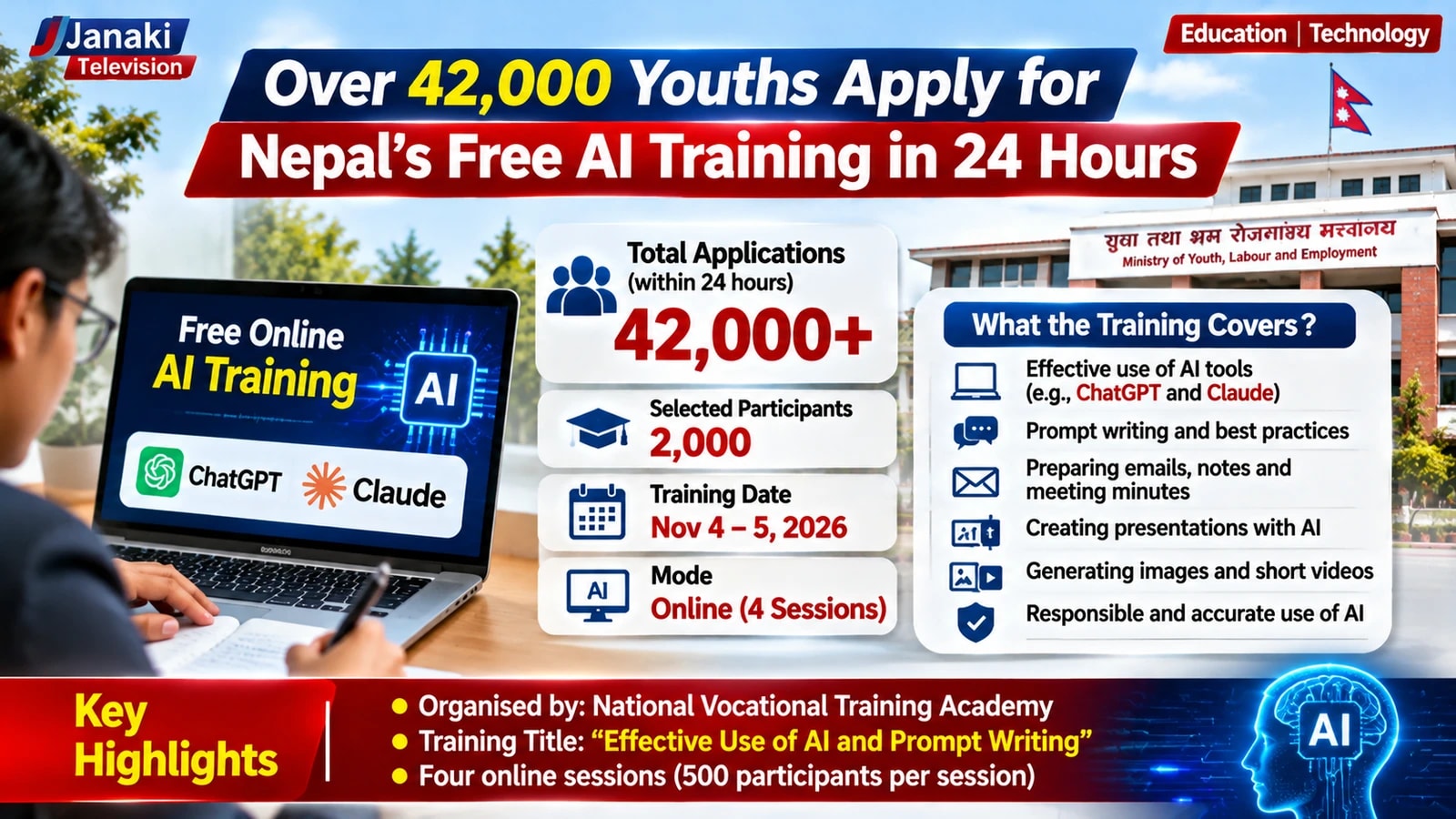
More than 42,000 young people applied for the government’s free online artificial intelligence training within 24 hours of applications opening. The programme, organised by the National Vocational Training Academy, aims to provide practical AI skills to 2,000 participants.
KATHMANDU: Nepal’s government has received an overwhelming response to its free online artificial intelligence (AI) training programme, with more than 42,000 young people submitting applications within 24 hours of registration opening.
The National Vocational Training Academy, operating under the Ministry of Youth, Labour and Employment, said the unusually high number of applications caused technical problems that temporarily disrupted access to the online application form.
The academy confirmed that applications successfully submitted had been safely recorded and would be used only for training-related purposes. Applicants who had already completed registration successfully were also advised not to submit another application.
The programme is designed to introduce young people to practical applications of artificial intelligence and help them develop skills that can be used in education, employment and professional activities.
Training Limited to 2,000 Participants
Despite receiving more than 42,000 applications, the academy plans to train only 2,000 participants in the initial programme.
The two-day training, titled “Effective Use of AI and Prompt Writing,” is scheduled for November 4 and 5.
It will be conducted through four separate online sessions, with 500 participants in each session. The sessions are scheduled for 10 am to noon and 6 pm to 8 pm on both days.
Selected participants will be informed about their assigned sessions through SMS.
ChatGPT, Claude and Practical AI Skills
The programme will focus on helping participants understand and use popular AI tools, including ChatGPT and Claude.
Participants will learn how to write clear and effective prompts to obtain useful results from AI systems. The course will also demonstrate how these tools can assist with everyday academic and professional tasks.
The planned training topics include:
- Using AI tools effectively for study and work.
- Writing clear and useful prompts.
- Preparing emails, notes and meeting minutes.
- Creating presentations with AI assistance.
- Generating images and short videos.
- Using AI responsibly and checking the accuracy of AI-generated information.
The programme is intended to move beyond basic awareness of AI by introducing participants to practical ways of applying the technology.
Government Seeks Wider Access to AI Education
Youth, Labour and Employment Minister Ramji Yadav said knowledge and skills related to artificial intelligence should not remain limited to a small group of people.
He said the initiative was designed to make basic AI knowledge and practical skills accessible to young people across the country as technology continues to create new opportunities.
The ministry also considers the programme an opportunity to assess the effectiveness of delivering live skills-based training through online platforms.
Based on the experience, the government expects to organise additional training programmes, including more advanced courses through both online and in-person formats.
Growing Interest Highlights Demand for Digital Skills
The response of more than 42,000 applicants for just 2,000 available places highlights the strong interest among young people in learning emerging technologies.
Artificial intelligence is increasingly being used in education, communication, business operations, content production and other professional fields. However, access to practical training remains an important challenge, particularly for people who have limited opportunities to learn these tools.
The programme's popularity indicates that affordable and accessible digital-skills initiatives could attract significant participation among Nepal's youth.
The immediate challenge for the government will be to expand such opportunities beyond a limited number of training places and ensure that participants gain practical knowledge they can apply in real-world settings.